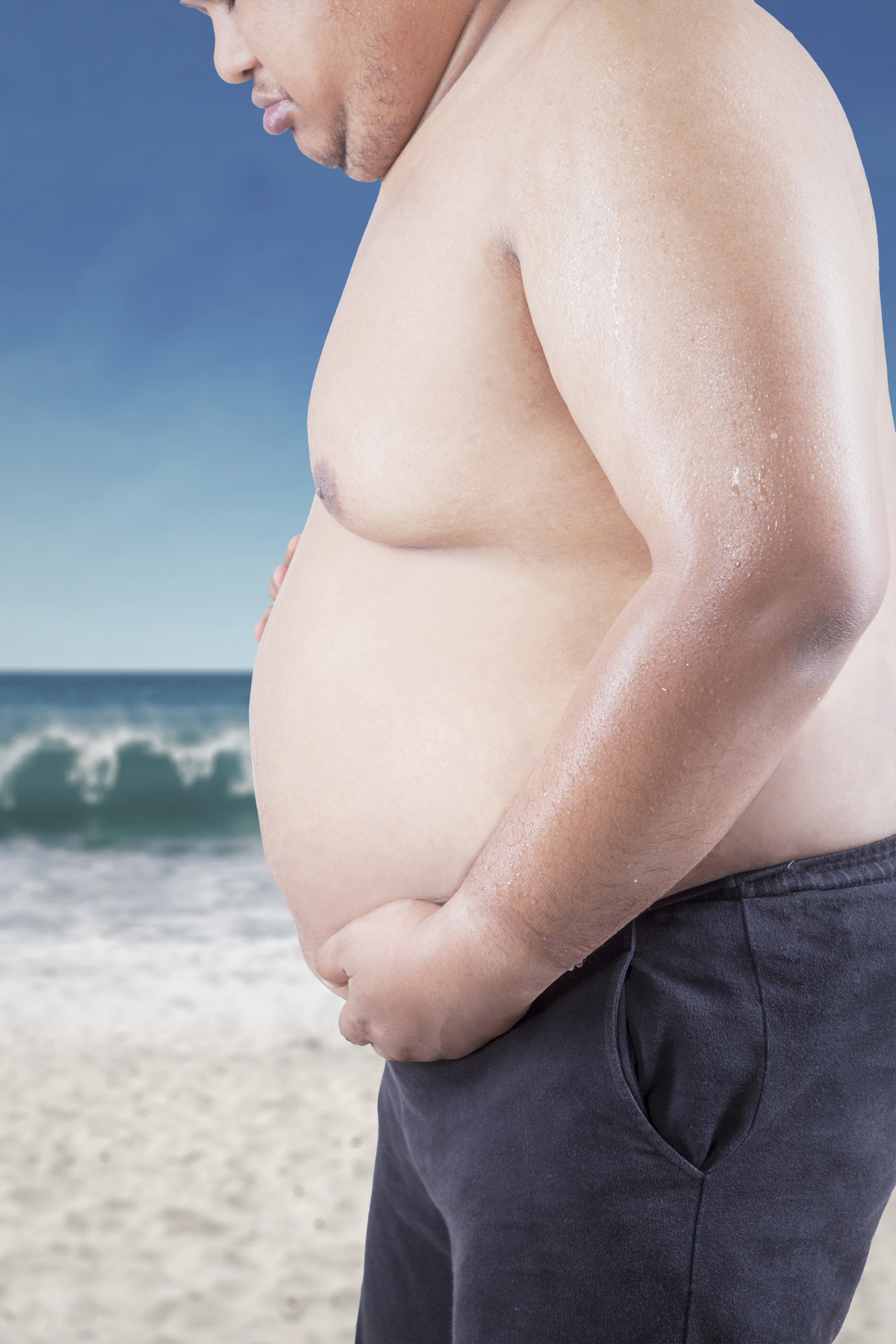
Closeup of unhappy person looking and holding his tummy on the beach

A regular client of mine struggles with love handles. His stomach looks and feels like a basketball. He also use to have “moobs”. I don’t particularly like the term. It stands for “man-boobs” which is an even worse term. The stigma attached to these unwelcome tenants is unfounded and hurtful … often leading to feelings of depression and low self-esteem. The correct term in most cases for enlarged male breasts is Gynecomastia.

After a year of faithful weightlifting, an active job and cutting out all sugar, my client lost most of his gynecomastia. With testosterone supplementation, he gained nice lean muscle. His body was transforming, but his love handles and distended gut remained. He still looked nearly obese.

“Why?” he asked. “Is there an exercise to “target” these areas?” 

Easier said than done. On men, these are the toughest areas to tackle and sadly, they can’t be eliminated through movements like side bends and crunches. In fact, chances are better than 50% that solving the underlying issue involves seeing a doctor. My eventually client went to the doctor and was prescribed testosterone. Three months later the stomach and love handles still remained.

Doctors will sometimes mistake the symptoms of gynecomastia, love handles and round gut for a low testosterone issue. But if the man is overweight and/or has an unhealthy liver, hormonal remedies (like testosterone cream or injections) will often fail. The body will likely convert the additional testosterone into more estrogen. This can worsen the original problem and also may risk enlargement of the prostate.

If you’re thinking about treatment for any of these issues, it may behoove you to consider the following:

  1. Improve the health of your liver. If your liver is healthy you will find it significantly easier to maintain a healthy body weight and your liver will break down excess estrogen effectively. 
  2. Ask your doctor to consider Hormonal Imbalance, Type 2 Diabetes, Insulin Resistance or Syndrome X. Fat cells in the torso will cause the body to manufacture Aromatase (raising estrogen levels once again) and elevate blood insulin levels.
  3. Weightlifting (linear and progressive, closed chain movements like the squat and deadlift) along with vigorous, sweat-producing explosive, steady state or HIIT cardio … all these have proven benefits in raising testosterone levels, elevating mood and well-being, and giving a big boost to fat metabolism.

Bottom line: You’ve done a thousand sit-ups a day and not seeing results? Check your diet, your liver and hormonal health. If you’re exercising regularly, you may not be pushing yourself quite hard enough. I don’t believe in extreme reps or boot camps, but I do believe you should be breaking a good sweat during cardio or training.  That requires 30 minutes or more of rigorous cardio and/or training, 5 days a week.

See you at the gym!

Vicki Morgan A.C.E. is a Strength and Fitness Trainer at Flex Gym. Reach her at victoryfitnessteam.com. (Thank you to The Liver Doctor for the medical information)

~ By Vicki Morgan, CPT

Young Adult Woman Consoles Sad Senior Adult Female.

I love fall. That cold slap in the face, the colors of desert sunsets sprinkling the trees, the smell of pine in the air … what a gorgeous, joyful time. For some.

For others it’s a grim reminder of the coming winter … a biting freeze that chills to the arthritic bone. The stifling, thick cold makes it hard to breath, makes the heart work harder, makes the hands hurt and grow numb … and it’s too bloody cold to walk outside. Fall and winter in Colorado are the roughest times of year to start an exercise program. The onset of cold can be quite discouraging to an already unmotivated soul.

In part one of this article, I talked about mental immobility. Not only is it depressing and de-motivating, it is internally, physically and mentally destructive. Mental paralysis can be born of fear, anxiety, depression, grief, despair, medication or disease. Those who have never suffered from immobility have no idea what it’s really like. A sufferer usually can’t just “snap out of it” or “visualize” their way out of it. In the latter section of part one, I unpacked what happens physically when we move our muscles ever so slightly. We learned in part one how just the slightest movement does a world of good. Even flopping around on the bed can be considered exercise. From the folds of our couch, from the fortress of our bed, even moving one limb activates a whole chain of physical reactions that cause you to become addicted to movement … and therefore addicted to exercise.

Consider this. If you’re mentally immobile and can’t get motivated to exercise, it may be due to the pressure that you feel to get fit. But here’s the deal. Wrong beliefs about physical activity may be counteracting your motivation. Here are just a few to consider:

  • Exercise has to be intense to be valid.  NOPE!  
  • You have to exercise at a certain time, and you have to commit to those hours. NOPE!
  • Reaching goals is a requirement for happiness and success. NOPE!
  • Exercise should be exhausting, not renewing or relaxing. NOPE!

Exercise does not have to be intense. It’s supposed to be YOU time. The “No Pain, No Gain” approach is dead. It’s old school. The old adage of “high intensity for at least 30 minutes” has been replaced by newer recommendations that permit lower-intensity activity in shorter durations. I have a client who is 78, and after one year of what I call “feel-good strength training”, she’s almost as strong as I am. She’s been sore maybe ONCE in that entire year. She feels decompressed and renewed after training … not beat up and spent. You can slowly, steadily do something at home every day, and YOU can pick the time! The only requirement is consistency. If you haven’t moved much in ten years, then kicking your legs for three minutes, twice a day on the couch is probably sufficient to start. Remember … exercise should never be a burden. It is a discipline, but it should be a joyful one.

Somehow, someway, if you try, you will come to love exercise. You may have to actually invent exercises that are fun for you personally. A more relaxed approach to exercise might boost your motivation as well. You can move in ways that will renew instead of exhaust you. Any movement is better than nothing. The world will keep turning if you miss a day.

One last note: If you’re being pressured by a concerned family member to “get in shape or die”, that in itself can be demotivating. Encouragement is ALWAYS better than a threat. Love is a better motivator than fear.

Now that the pressure is off, try enjoying a bit of movement. In the last part of this short series, I’ll give you some ideas for “feel good” strength training that you can do at home.

Vicki Morgan A.C.E. is a Senior Strength & Fitness Trainer at Flex Gym and Fitness. She is also a professional blog writer and audio podcast producer. Consult a physician before beginning any exercise program. If you experience pain or difficulty, stop and consult your healthcare provider. This article is not meant to take the place of any treatment or activity your physician has deemed necessary. 

REFERENCES: Contributed and/or Updated by: Anish R. Kadakia, MD
Peer-Reviewed by: Stuart J. Fischer, MD; Steven L. Haddad, MD

Getting out of bed in the morning can be a daunting task in Life After 50 Paradise. Some of us can’t straighten up. We slide off and then slump over the bed, allowing for what appears to be a moment of prayer but it’s actually a chance to relish the last vestiges of a gravity-free day. As we accordion-walk our way to the bathroom, various aches, pains and mental issues creep in. Growing older is a great way to stay humble … if you’re concerned about spiritual growth that is. For others … it’s just a pain in the gluteus.

Even with 45 minutes of cardio a day, stretching, powerlifting, weight training and personal training … at age 55 it’s getting harder for me to get out of bed.

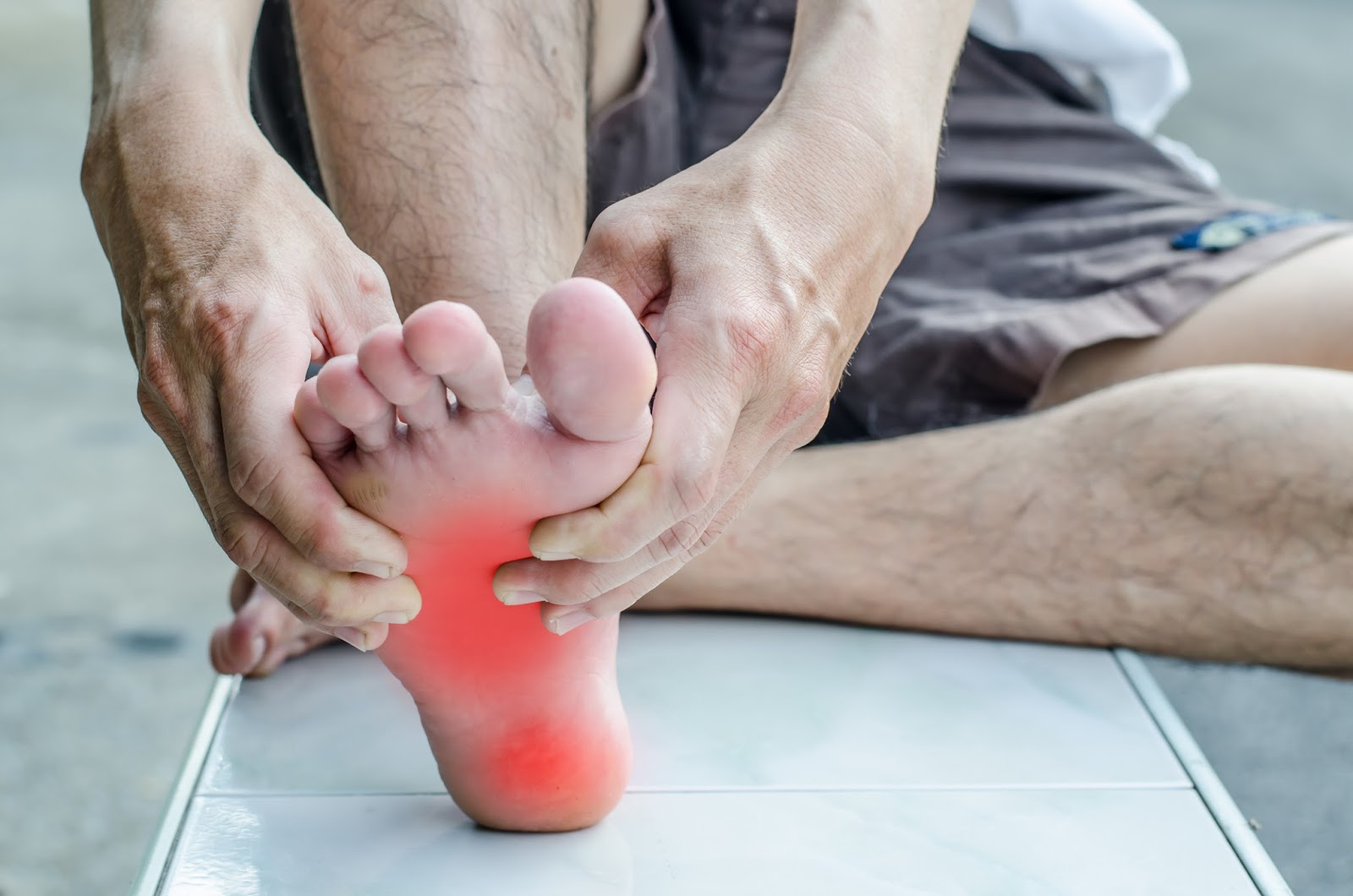
But not nearly as hard as for those who suffer from Plantar Fasciitis.  If the bottom of your heels hurt after sleeping, sitting or during exercise, you may have PF.  There’s a fibrous “rubber band” that stretches along the bottom of your foot. It’s supposed to be nice and springy, absorbing the stress and pressures you place on your feet. But too much stress without adequate flexibility will cause injury to the tissue. As we age, we lose elasticity, plasticity and lubrication … affecting us in places like the Plantar Fascia and Achilles tendon. The body responds with painful inflammation and hence … you’re tip-toing to the bathroom. The pain is sharp … severe enough to discourage anyone from doing physical activity.

It may feel like a bone spur, but it may not be a spur. And good news here … if you do have a spur, it is probably NOT the cause of your pain. Again … heel spurs do not cause much foot pain (This from the American Academy of Orthopedic Surgeons).  Only one out of ten people have heel spurs, but only 5% of those have foot pain. So it’s important to note that spurs do not cause plantar fasciitis, and therefore your pain can be treated without removing the spur.

If your doctor wants to take X-rays, please don’t treat him/her like he/she’s the devil. It’s common for doctors to use X-rays to rule out arthritis or hairline fractures. Typically an MRI will be suggested only when initial treatments don’t relieve pain. Surgery is almost never considered without at least 12 months of non-surgical treatment. Most PF sufferers do well after surgery. But surgery can also result in more chronic pain and immobility. Complications of PF surgery include failure to relieve pain and nerve damage. For this reason, The American Academy of Orthopedic Surgeons recommendeds surgery only after all nonsurgical measures have been exhausted. So let’s avoid it altogether if possible, okay?

TREATING AND/OR AVOIDING PLANTAR FACIITIS
If you’re overweight, have high arches, are engaged in repetitive exercise and/or have begun a new activity, then you’ll want to nip PF in the bud before it stops you from doing the things you love. Here are the things you can do to be proactive in avowing and treating PF:

  1. Stretches – Plantar
    fasciitis is awakened by taut muscles in your feet and calves. Stretching and
    massaging your calves, plantar fascia, feet and Achilles tendon is the most
    effective way to relieve the pain and avoid this condition.  I always guide my clients into stretching
    after a workout. Some of them complain that my flexibility lessons are a waste
    of their time and money. I tell them it’s not about the money. It’s my way or the highway on this subject.
  2. Cortisone injections – Cortisone is an anti-inflammatory steroid, injected into the
    plantar fascia to reduce inflammation and pain. Your doctor may limit
    injections, and rightly so. Too many steroid shots can cause ruptures which
    lead to “flat foot” and exacerbated pain.
  3. Supportive shoes and
    orthotics –
    Get supportive shoes with thick soles and cushioning to
    reduce pain. Please don’t cling onto those dilapidated, stained, lopsided shoes
    for one more second. Spend some bucks and spring for a GOOD pair. A cushioned
    shoe reduces tension and micro-trauma to the Plantar Fascia. Soft silicone heel
    pads, store-bought and custom orthotics may also prove helpful.
  4. Night splints – Most folks sleep with their feet pointed down, which relaxes the
    plantar fascia and causes morning heel pain. Try sleeping with the PF stretched
    instead. I do this with my toes up against my blanket. If you can’t do it, ask
    your doctor about a night splint. A Night
    splint is not for wimps. It is uncomfortable but very effective.  Once the pain is gone, you won’t need to wear
    it anymore.
  5. Physical therapy – A
    personal trainer can show you how to stretch, but if you can’t do it yourself,
    a Physical Therapist will stretch your muscles and fascia for you.
    Physical Therapists are also licensed to apply specialized ice treatments,
    massage, and medication to decrease inflammation.
  6. Extracorporeal shockwave
    therapy (ESWT) –
    Powerful shockwaves that stimulate
    the healing process in damaged tissue. This is a fairly new procedure. Two of
    my friends have had this done with terrific results, but clinically it is still
    not a tried and true procedure. Because of the minimal risk involved, ESWT is
    sometimes preferred before surgery is considered.

Questions? Email me at victoryfitnessteam@gmail.com. See your happy feet at the gym!

Vicki Morgan A.C.E. is a Senior Strength Trainer at the YMCA Franklin and a Stretch Practitioner at Stretch Zone in Tollgate Village TN. Reach her at seniorstrength.net. Always consult your physician before beginning any exercise program. If you experience pain or difficulty, stop and consult your healthcare provider. This article is not meant to take the place of any treatment or activity your physician has deemed necessary. 

5c5084cca32d34a84d00f54b822ccd19TAKE A LICKING, KEEP ON TICKING.
Well, congratulations. Not only did you make it through another year, you are now a member of an elite class of people who “refuse to stop moving.” If you’re a baby boomer or a little older, you are part of the first generation that refuses to quit exercising. This observation comes from Dr. Nicholas DiNubile, an orthopedic surgeon who specializes in sports medicine. He is a clinical assistant professor at the Hospital of the University of Pennsylvania. Around 1997 he realized that he was treating an increasing stream of older adults who refused to temper their exercise as they got older. That’s great. But there’s a downside. We’ve extended our life span, but we have not extended the warranty on our muscles, bones, joints, tendons, tissues and spinal disks. They all deteriorate with time. While DiNubile encourages seniors to exercise regularly, he recommends moderating or diversifying activities to avoid overuse injuries.

In my case, I’m a competitive powerlifter. At age 50, I noticed lifting began to take its toll. In order to stay in the game and avoid serious injury, I had to radically change my training strategy. I used to train high reps. Now I concentrate on strength … building endurance with explosive (HIIT) cardio instead. At age 55, I still hold national records and manage to place in the top 5 at any given meet. But I only aim for one meet a year instead of three.

THE PROBLEM WITH REPS
Those of you who do CrossFit, jogging and other repetitive impact sports may notice your joints, tendons and spine showing signs of wear. Don’t wait until your discs are compressed or your knees have to be replaced. Find a sport that allows you to get strong without so much repetition. Or take more rests, even if it means extending your training session. At the very least, make sure you’re doing plenty of self-care like massage, foam rolling, body work, stretching and Jacuzzi.

A YEAR OLDER, A YEAR WISER
Dr. DiNubile observes, “Every time I’m in the office, I’m treating someone who’s been injured in their effort to be fit.” But don’t let the fear of injury put you on the couch. The human body was made to be used. So apply that wonderful wisdom … and maybe some common sense.  With all the new information available about smart training, target-supplementing and healthy eating, it’s no wonder that older swimmers are turning in their fastest times ever. It’s no wonder that men and women in the 70’s, 80’s and even 90’s continue to build strength and muscle mass. Weight training is not the enemy. It can reverse osteopoenia and even osteoporosis. It can actually make muscles younger, according to a study by the Buck Institute for Age Research. Researcher Simon Melov examined the mitochondrial function of muscle of people 65 and older and compared the results with those in their late teens and 20’s. He took samples of muscle tissue before and after six months of resistance training and found that the older people’s muscles had genetic characteristics similar to the muscles of the younger folks. Kind of gives meaning to the phrase, “New Year, New You.” The difference is … you’re not 20. You’re older and much wiser. So train smart, train humbly, and stay in the game.

Vicki Morgan A.C.E. is a Senior Strength & Fitness Trainer at Flex Gym and Fitness. At age 55, she enjoys competitive powerlifting and bodybuilding. Always consult your physician before beginning any exercise program. If you experience pain or difficulty, stop and consult your healthcare provider. This article is not meant to take the place of any treatment or activity your physician has deemed necessary. 

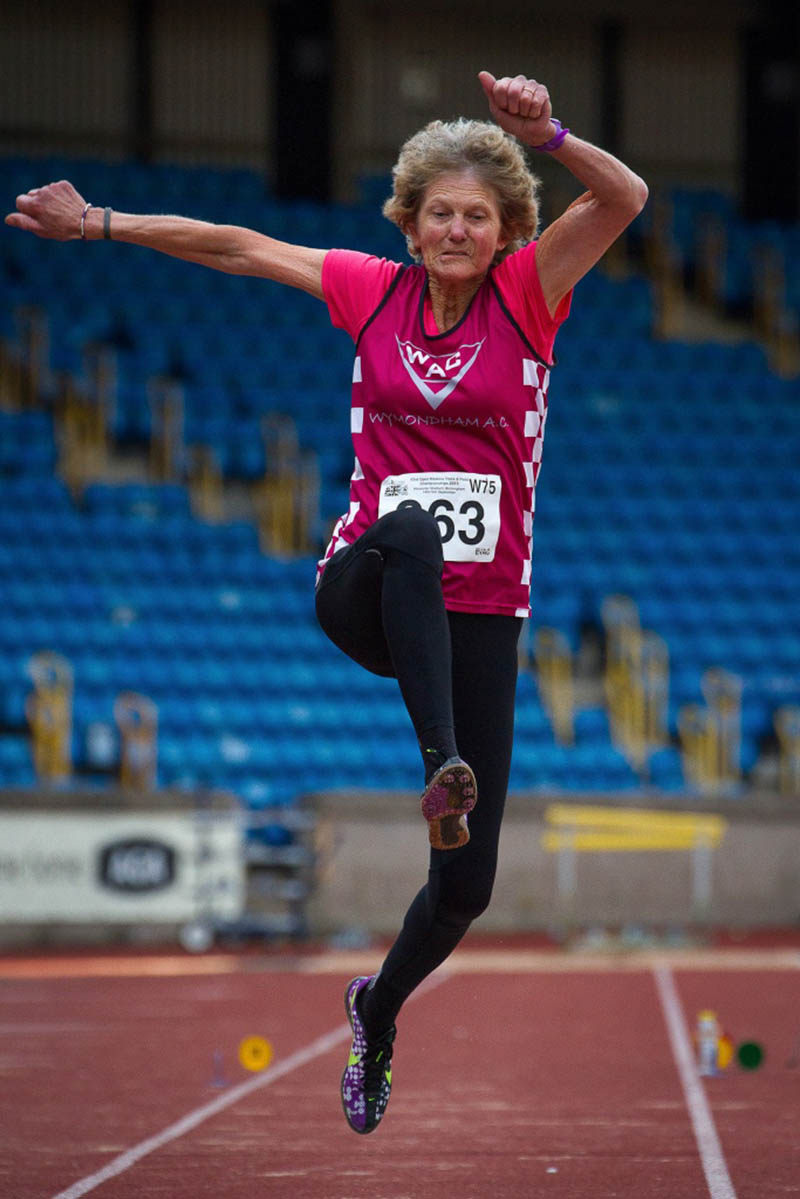
 **Photo Caption: Anne Martin, born 1936. She won the triple jump for women ages 75-79 with a leap of 6.47 meters. Photo by Alex Rotas.

AA2
What the heck? I had just done a 285 deadlift at 111 bodyweight, and decided to do a nice light 135 warm down set. Suddenly … a TWINGE.

The TWINGE is like a musician who hit a wrong note. Everything’s off. The song is no good. You can’t tune the guitar because the string is too stretched out. Do us all a favor and QUIT while you’re ahead. The band wants YOU to QUIT.

A TWINGE is that vague feeling that you did something wrong. It felt like a muscle being twisted in the wrong direction. But only a small muscle. And only for a short time. It goes away fast. So it must be ok, right?

WRONG-O.

A twinge, left to it’s own devices will wreak havoc on the nearest possible attachment/joint/ligament … whatever you got, it’s goin’ for it. A twinge is NOT your friend. So stop the workout NOW, stud, before you’re out for a week. A twinge usually occurs when you’re most confident. Warm-ups, warm-downs, off-loading plates, picking up dumbells, being cocky.

A twinge ignored will come back 1-2 weeks later in the form of a TWEAK. You will TWEAK the thing that TWINGED. And this time, you will make a “tweak” face. A scrunched up nose and a sour lemon expression. Now you are unable to move without pain, and some sort of limp or other compensation. You’ve tweaked something. Something in your body is now arranged improperly, and it’s going to take a few days to a week to recover. Your sex life may be impaired. Your joy may be temporarily robbed unless you have Jesus. And even then, life is gonna suck for you.

Some powerlifters truly believe that they can lift through a tweak. And when they do, they receive a TORQUE as their just reward. A “torque face” is a face of utter doom. You CANNOT move without help. You will not lift. Your muscle has rolled up, your nerve has folded over, your rib has sprung hopelessly out of position. You have TORQUED yourself. A TORQUE is usually followed by the sentence, “I’m gonna be out for awhile”.

My only advice is this: If you feel a twinge, STOP. The weights will be there tomorrow.
If you are tweaked or torqued, here is an excellent website about pain management: https://www.painscience.com/

And if you want to improve your form, for the Lord’s sake, train with me:
http://www.victoryfitnessteam.com

See you in the gym!
Vicki

10924780_931504983540173_8447889183511238457_n FEAR. Fear of getting older. Of being hunched over. Of falling and not being able to get up. Of breaking a bone that never heals.
And because you’re getting older, you think that avoiding “dangerous activity” like lifting weights is the answer. Just stay away from anything that causes micro trauma to your bones, and you’ll be safe from harm. Just stay away from those meatheads in the gym. Don’t do anything strenuous. Preserve thyself.
Right? WRONG-O.
Enter the big bad wolf … Wolff’s Law, that is. He’s gonna huff and puff and blow your cowardly bones into dust.
Wolff’s Law (actually pronounced vulf) states that, “The principle that every change in the form and the function of a bone or in the function of the bone alone, leads to changes in its internal architecture and in its external form”.
German anatomist / surgeon Julius Wolff stated and proved that healthy bone conforms or adapts to loads under which it is placed. If the weight increases, the bone becomes stronger over time to meet the challenges it’s been faced with. Those changes occur both internally and externally. Conversely, if you lighten your loads, the bone becomes weaker and less dense over time.
Our bones are constantly changing. And believe it or not, YOU are the boss. YOU show them how to grow. How dense to be. How to handle loads. YOU train your muscles to be able to pick you up off the floor. YOU decide what you’re going to weigh, and YOU take control.
It’s NOT too late. It’s never too late. Numerous studies were done on people in their 80’s and 90’s. As soon as they started strength training, their strength increased threefold in just one month.
So if I were you, I’d start building a house of brick. A Brick House. Mighty, mighty. Just start laying down the layers and let the big bad Wolff in.
Vicki Morgan
http://www.victoryfitnessteam.com

Go back

Your message has been sent

Warning
Warning
Warning
Warning

Warning.

Training Training Training!!

Posted: October 19, 2015 in Uncategorized

Currently training for the 2016 NPC Southern in Colorado Springs!

Currently training for the 2016 NPC Southern in Colorado Springs!

DSC_6747

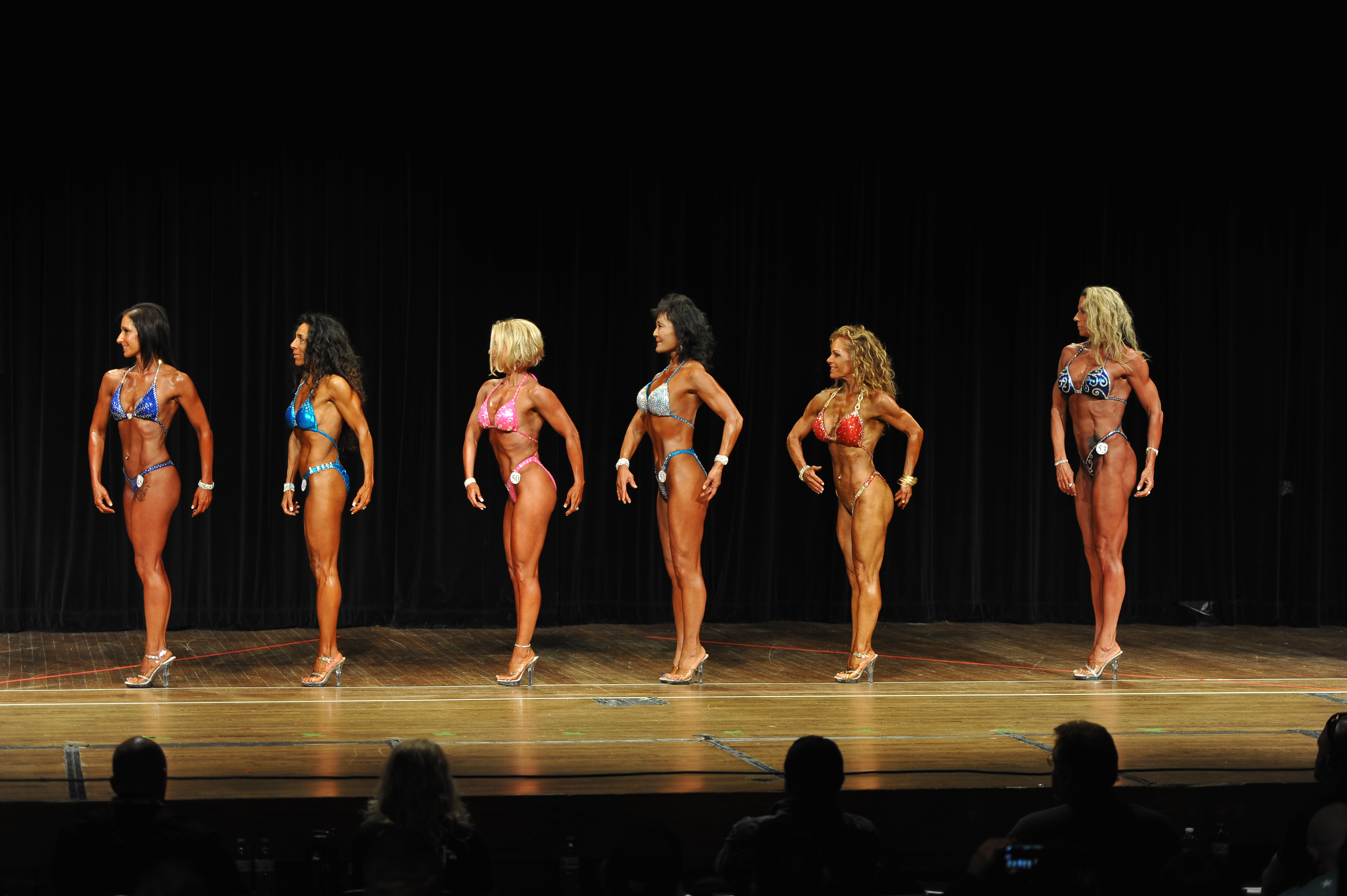
Me and the 50+ girls at the 2015 NPC Southern in Colorado Springs

The 2014 WARRIOR! My first bodybuilding show at age 50.

The 2014 WARRIOR! My first bodybuilding show at age 50.

Read the rest of this entry »

Which Shoes Should I Choose?

Posted: April 1, 2012 in Uncategorized

My husband calls me the Imelda Marcos of the powerlifting world.  Imelda owned hundreds of shoes.  I have owned and tried probably 10 or more shoes for powerlifting.  Breakdancing, army grade, wrestling, basketball, fancy squat shoes, cheapo LA Gear, running shoes … tried em all.

Your feet, your legs, your balance points are uniquely yours.  What works for one person, isn’t necessarily going to work for you.  You have to know your strengths and weaknesses before you choose your shoe.

For instance, in squats, if your strength is in your quads and you are more comfortable leaning forward for balance,  then your feet are probably closer together, your bar is probably lower for counterbalance, and you may keep your head forward.  In that case, the Crain or USA Safe squat shoes are probably for you.  You can wear em nice and tight, they keep your ankles stable and tilt ever so slightly forward with a 3/4″ heel.

BUT if your power is in your hips, you have a wider stance and no problem getting deep enough … if you have a mid to high bar and your toes point outward, you may have better luck with a nice flat Converse, wrestling or even the Vibram Five Fingers.  (By the way, don’t bother with any other brand but Vibram. I almost bought the Vibram’s and still might).

Point is, you’ve GOT to know YOUR STRENGTHS before you choose your shoes.

FOOT PROBLEMS:  I started getting foot cramps.  I also used to pull groin muscles and hamstrings during my deadlifts and squats.  I would recover, but it was a pain the _____.  I tried everything.  At first I thought it was nutrition (potassium/calcium), but it wasn’t.

SOLUTION:  I went to the foot experts at Trade Home in Colorado Springs.  He brought out every conceivable pair of shoes…each one addressing a different problem.  I found the exact combo for me, even though they’re a little clunky.  It’s a pair of Nike 6.0’s with an insert by SofSol called Athlete.  Keeps the shock and weight off my arch and heel, sinks me into the pocket and the soles are super grippy and flat. Alot of people like that forward tilt, but I can’t stand it.

WEAKNESS:  Now, if you want to build on your weaknesses, get the exact opposite pair of shoes that you need.  For me, it’s a pair of Crain Squat Shoes.  Ricky Crain is an expert.  Look him up.  I hate my Crain’s because they make me work my quads, narrow my stance and stiffen my ankles.  But talk about a good workout, and a good way to build on my strengths.

HAPPY SHOE SHOPPING!


Powerlifting chicks.  Not to be confused with Bodybuilding chicks.  We’re a strange breed.  We prefer to lift heavy things rather than show off our derrieres in a bikini.   We’re corn fed, tough but warmhearted.  The best powerlifting chicks are the ones that encourage and support other lifters.  Powerlifting chicks don’t have to be thin, graceful or pretty.  They just have to be strong.

Oh and by the way, if the word CHICK offends you, you should probably go back to the treadmill.

My name is Vicki Morgan.  I’m 49 years old.  I’ve been powerlifting for about 9 years off and on. I’ve only been seriously lifting for two years.  I hold world, national and state records in three out of four lifts.  More about me in another post.

Powerlifting is a pretty loose term.  You can lift EQUIPPED or UNEQUIPPED (raw).  Equipped powerlifters wear supportive gear to increase their numbers. It is a completely different sport form than RAW powerlifting.  Raw lifters aren’t allowed to wear supportive gear.  Lately, they’ve allowed raw lifters to wear wrist wraps, knee sleeves and belts … but it doesn’t change the numbers significantly.

It all comes down to COEFFICIENT.  How much percentage of your body weight can you lift?  That’s the number you’re shooting for … not the amount of pounds.  In other words, if a 198 gal can bench press 145 pounds, that’s awesome.  But not as awesome as a 114 pound gal that presses 125.

This is the decade of the powerlifting chick.  It used to be easy for chicks to set records.  Now, there’s a whole new breed of lifter, willing to lose their lunch at every workout.  Crazy women of the fall, the new generation, born out of sports like crossfit and mudding.

I don’t recommend insane sacrifices.  I DO recommend a long term, train smart approach that will keep you lifting long into your 60’s.  So stick with this blog.  You’ll get the best advice for chicks right here, especially for those of us 30 and older.  HAPPY LIFTING.